

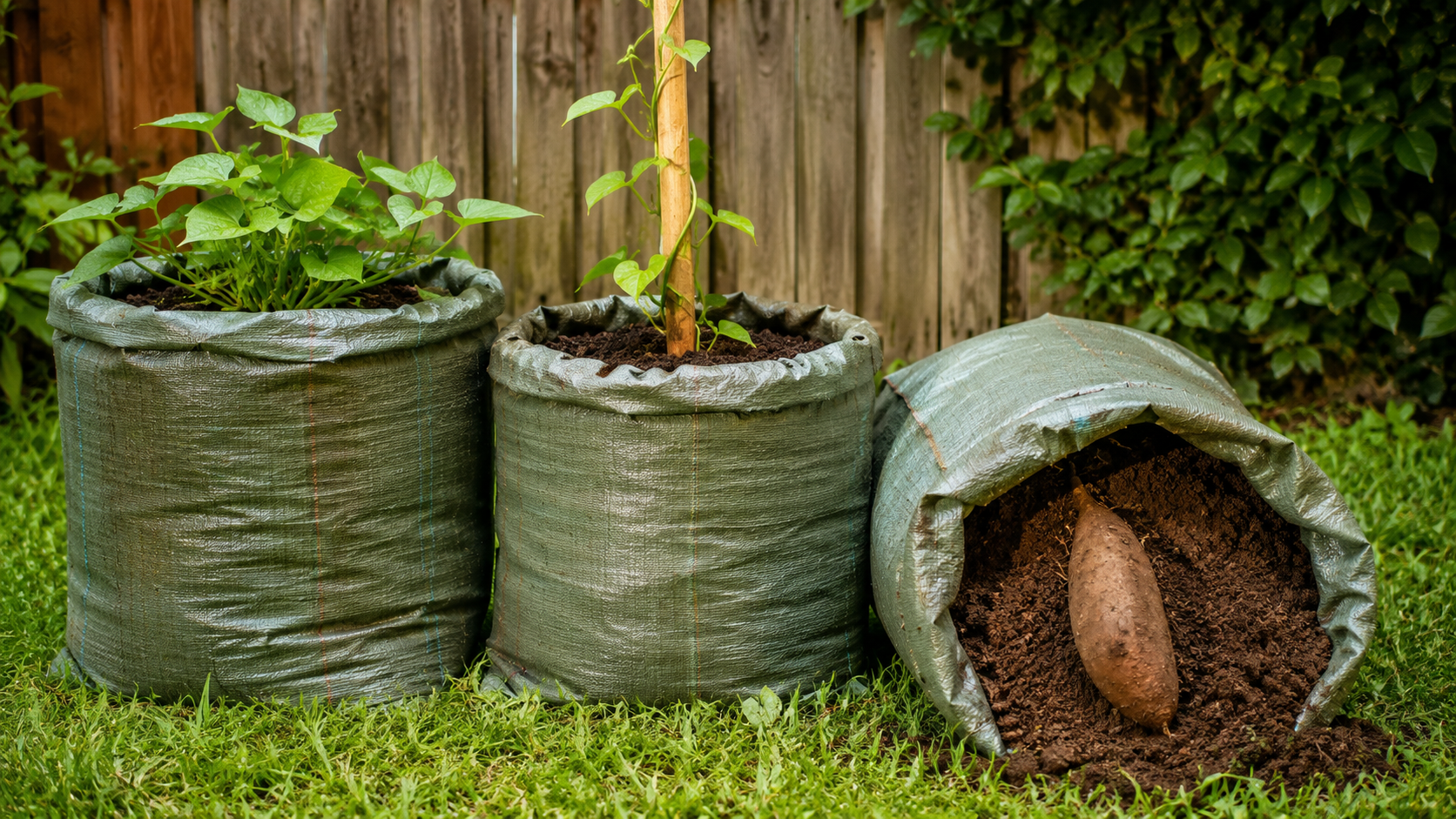
How To Start Yam Farming From Your Backyard With Sacks Bags
You read that right. Yam farming. In your backyard. In sacks.
I know what you’re thinking: Yams? Those massive tubers that swallow half a village’s labor during harvest? Those things that need an acre of loose soil just to breathe?
Yeah. Those same yams.
But here’s the kicker: you don’t need a farm. You don’t need a tractor. You don’t even need perfect soil. What you need is a few empty sacks bags, some decent compost, and the stubborn belief that a tuber the size of a toddler’s torso can thrive inside a woven polypropylene bag.
I’ve been testing this for three cycles now. My backyard looks like a potato sack convention. And last harvest? I pulled out yams that made my neighbors walk past my fence twice just to stare.
So if you’ve got ten feet of unused space behind your house, a hunger for something different, and zero desire to rent a rotavator, pull up a bucket. We’re going to break down exactly how to start yam farming from your backyard with sacks bags — and we’re going to do it in a way that actually works.
Why Sacks Bags? (And Why Your Grandfather’s Method Is Over)
Let’s clear something up immediately. Traditional yam farming is a backbreaker. You mound soil into heaps the size of small cars. You wait for rain like a prayer. You battle nematodes, yam beetles, and the creeping realization that your best tubers are three feet underground.
Now imagine this instead:
- You fill a sack bag (the same type used for rice, beans, or cement) with loose growing medium.
- You poke a few drainage holes.
- You plant a yam set (a chunk of seed yam) just below the surface.
- You water. You wait. You harvest by simply tipping the bag over.
No digging. No double-digging. No chiropractor bills.
The Right Sack Bag: Size, Material, and Where to Find Them
Not all sacks bags are created equal. I’ve made the mistake of using thin produce bags. Let me tell you: nothing is sadder than a yam root punching through rotting polypropylene two months before harvest.
Here’s what actually works.
Material:
Go for woven polypropylene. These are the heavy-duty sacks that hold 50kg of rice or animal feed. They breathe enough to prevent root rot but retain enough structure to support a growing yam. Avoid jute or hessian sacks — they rot too fast when kept moist.
Size:
Minimum 50-liter capacity. Better: 80 to 100 liters. Why? Yams need depth. The tuber is a geophyte; it wants to travel downward. A shallow sack will force the yam to curl into a deformed knot. A deep sack gives you a straight, marketable shape.
Where to source:
- Rice mills (they sell used sacks for pennies)
- Animal feed stores (new sacks, $1–$2 each)
- Online marketplaces (search “woven sack bags gardening”)
Pro tip: Wash used sacks with a 10% bleach solution. You don’t want to inherit someone else’s fungal spores
Preparing Your Yam Sets: The Difference Between a Harvest and a Heartbreak
You cannot just throw a grocery store yam into a sack and hope for the best. I tried that. What I got was a rotting mush that attracted flies from three blocks.
Here’s the real method.
What is a yam set?
A yam set is a piece of a mature yam tuber, cut into seed-sized chunks, each with a piece of the “head” (the proximal end where the sprout emerges). Without that head piece, you’re planting a slab of starch that will rot before it roots.
How to cut yam sets:
- Select a disease-free, medium-sized yam (avoid tubers with cracks or soft spots).
- Cut the yam into pieces weighing 200–300 grams each.
- Ensure each piece has at least one eye (the dormant sprout) — ideally two.
- Dust the cut surfaces with wood ash or sulfur powder. This prevents fungal attack.
The curing step (non-negotiable):
After cutting, leave the yam sets in a dry, shaded, well-ventilated spot for 3–5 days. A cardboard box under a tree works perfectly. This allows the cut surfaces to form a corky layer (suberization). If you plant immediately, the raw wound will absorb excess moisture and rot.
Mixing the Growing Medium: Because Sacks Bags Aren’t Soil
Here’s where backyard yam farming gets interesting. You’re not planting in native ground. You’re building an artificial environment inside a sack bag. That means you control every variable: drainage, aeration, nutrients, and pH.
Do not — I repeat, do not — use straight garden soil. It will compact into concrete inside the sack, drown your yam sets, and give you nothing but regrets.
The ideal mix (by volume):
- 40% good topsoil (sifted to remove rocks and clay clods)
- 30% well-rotted compost or aged manure
- 20% coco coir or rice husks (for aeration)
- 10% sharp sand (for drainage)
For the obsessive (that’s me):
Add a handful of neem cake (repels nematodes) and a cup of bonemeal (slow-release phosphorus for root development).
Filling the sack:
Fold down the top of the sack bag to make a collar about 12 inches tall. Fill the sack one-third full with your mix. Tamp lightly (don’t compress). Then place your cured yam set on top, sprout-side up. Cover with another 4 inches of mix. As the vine grows, you’ll gradually unroll the collar and add more mix — this encourages the yam to form higher up in the sack.
Planting: Timing, Depth, and Spacing
When do you plant? At the start of the rainy season — or whenever you can control watering if you’re in a dry region. For most tropical and subtropical backyards, that means April through June.
Depth:
Place the yam set 4 inches below the surface. Too shallow, and the developing tuber will push itself out of the soil (called “tuber popping”). Too deep, and the sprout will exhaust its energy before reaching light.
Spacing between sacks:
If you’re running multiple sacks bags, leave at least 2 feet between them. Yams vines climb, and they’ll strangle each other if crowded. Each sack is one yam plant. This isn’t corn; you don’t pack them in.
Staking:
Here’s something most “how to start yam farming from your backyard with sacks bags” guides forget: yams vine. Aggressively. Within 3 weeks, you’ll see a twining shoot looking for a vertical surface.
Drive a 6-foot wooden stake into each sack bag at planting time. Or lean a bamboo pole against a fence. Without support, the vine will crawl across your yard, tangle into a knot, and produce a tiny, stressed yam.
Watering, Feeding, and Hilling (Yes, Even in a Sack)
You thought hilling was only for field farmers? Wrong. Inside a sack bag, hilling is even more critical.
Watering:
Yams dislike two things: drought and waterlogging.
- First 8 weeks: Keep the mix evenly moist but not wet. Stick your finger in up to the second knuckle. If it’s dry, water. If it’s muddy, wait.
- After 8 weeks (when the vine is climbing): Reduce water slightly. This forces the plant to invest energy into tuber swelling.
- Last 4 weeks before harvest: Stop watering entirely. Dry stress triggers starch conversion and thickens the skin for storage.
Feeding:
Yams are heavy feeders. Every 3 weeks, give them:
- Compost tea (steep a sack of compost in a bucket of water for 48 hours, dilute to weak tea color)
- Or liquid seaweed (follow label for root crops)
- Or a handful of aged poultry manure scratched into the surface
Stop all feeding 6 weeks before harvest. You want the yam to cure in place, not keep growing soft tissue.
Hilling inside a sack bag:
As the vine grows, unroll the folded collar of the sack and add more growing medium around the base of the stem. This does two things:
- Prevents the developing yam from pushing up into sunlight (which turns it green and poisonous).
- Gives you a longer, larger tuber because the yam keeps sending roots downward from the buried stem nodes.
By the end of the season, your sack bag should be completely unrolled and filled to the brim with mix.
Pests and Diseases (Because Nothing Is Perfect)
Let me be honest with you. Growing yams in sacks bags reduces 80% of the pest problems from field farming. But that last 20%? Annoying.
Yam nematodes:
These microscopic worms cause “dry rot” and cracked tubers. Prevention is everything.
- Use neem cake in your initial mix.
- Never plant yams in the same sack bag two seasons in a row.
- Rotate with marigolds or sorghum between yam cycles.
Yam beetles (Heteroligus):
Adults eat holes in tubers. Larvae chew roots. In a sack bag, you can actually see them.
- Hand-pick beetles at dusk (they’re slow).
- Sprinkle wood ash around the base of the vine.
Fungal leaf spots:
Caused by overwatering or poor airflow between sacks bags.
- Space your sacks as recommended.
- Remove and burn yellowed leaves.
- Spray with diluted neem oil (1 tsp per liter) once a week during wet weather.
The beauty of backyard yam farming is that you can inspect every plant daily. You’ll spot trouble before it spreads.
Harvesting: The Moment You’ve Been Waiting For
After 7 to 9 months, the vine will yellow, wither, and die back. This is not a tragedy; it’s a signal.
Stop watering completely. Wait 2 more weeks. Then:
- Cut the dead vine off at soil level.
- Lay a tarp on the ground.
- Tip the sack bag over onto the tarp.
- Unzip the side seam (if it has one) or carefully cut the bag open with a knife.
- Gently brush away the mix. Your yam will reveal itself like a buried treasure.
What to expect:
- First-time yield: 4–8 pounds per sack bag.
- Second cycle with better mix: 10–15 pounds.
- With perfect conditions (humidity, temperature, obsessive feeding): I’ve seen 22-pound yams from a single sack.
Curing harvested yams:
Do not eat them immediately. Fresh yams are starchy and watery. Cure them instead:
- Lay tubers in a single layer in a shaded, airy spot for 7–10 days.
- Do not wash them; leave the soil on.
- After curing, brush off dirt and store in a cool, dry place.
Cured yams can last 4–6 months without refrigeration.
Why This Works for Backyard Farmers (And Why You Should Start Now)
Let me count the ways.
No land required. A 10×10 backyard can hold 20 sacks bags. That’s 20 yam plants. At 5 pounds each minimum, you’re looking at 100 pounds of yams from a space smaller than a parking spot.
No soil degradation. You control the mix. You can reuse the growing medium for tomatoes or peppers the next season. No fallow period needed.
No heavy lifting at harvest. Traditional yam harvesting is a full-body workout. Sack method harvest is tipping a bag onto a tarp. My 70-year-old mother does it without groaning.
Market advantage. Backyard yams grown in sacks bags are straighter, smoother, and less blemished than field yams. Restaurants pay a premium for uniform tubers.
And here’s the part that gets me excited: you can start this week. Today. Even if you’ve never grown anything more complicated than basil.
Frequently Asked Questions (For the Skeptics and the Curious)
Q: Can I use any sack bag, or does it have to be new?
Used is fine, but avoid sacks that held chemicals (fertilizer bags are okay; pesticide bags are not). Wash thoroughly.
Q: How many yams per sack bag?
One. Two at absolute most, but you’ll get smaller tubers. Yams are solitary rooters.
Q: Do I need to use seed yams from a store?
Ideally, get certified disease-free seed yams from an agricultural extension office. Grocery yams sometimes carry viruses. That said, I’ve used grocery yams successfully — just cure the sets extra long (7 days).
Q: What about yam mini-setts?
If you can find pre-sprouted mini-setts (20–50 grams), they work even better. Higher survival rate, less rot.
Q: Can I do this indoors?
No. Yams need full sun — at least 6 hours of direct light. A bright patio works; a basement does not.
Q: How do I know if my yam set is rotting?
Soft, black, foul-smelling. Pull it out immediately and replace with a new set.
Final Verdict: Your Backyard Is Lying Fallow. Change That.
You don’t need to wait for the perfect season, perfect soil, or perfect weather. You just need a few sacks bags, a handful of yam sets, and the willingness to ignore anyone who says “yams can’t grow in containers.”
I’ve done the failure cycle so you don’t have to. I’ve lost sets to rot. I’ve had sacks split open mid-season. I’ve harvested yams the size of golf balls. But I’ve also pulled out tubers that made me laugh out loud — massive, perfect, grocery-store-defying yams that started exactly where you’re starting now.
So here’s your assignment for the weekend:
- Find three used sacks bags.
- Mix up a batch of growing medium using the 40/30/20/10 recipe.
- Cut, cure, and plant three yam sets.
- Water. Wait. And in 7 months, tip over a bag and prove to yourself that yam farming doesn’t require a farm.
You’ve got the guide. You’ve got the method. Now go get your hands dirty.
