
From Waste to Wealth: Your Blueprint for a Palm Oil Processing Business in Nigeria
I want you to imagine a business where the demand is so high that the nation of Nigeria actually has to import $600 million worth of the product just to keep the lights on. Imagine a business where even the “waste” you produce can be sold for profit. That is the reality of the palm oil processing business today.
If you are reading this, you are likely looking at the palm oil value chain and wondering where you fit in. Maybe you have the land, maybe you have the capital, or maybe you just have the hunger to stop working for someone else. I have synthesized hundreds of pages of market reports and case studies to give you the unfiltered truth about this industry. Let’s walk through the journey, the pitfalls, and the massive opportunities waiting for you in this sector.
1. The Nigerian Advantage: Why You Should Enter Now
Before I tell you how to process, let me convince you why you need to start. Many people look at imported goods as “high quality,” but in the palm oil processing business, the advantage is local.
First, look at the supply and demand gap. Nigeria consumes over 2.5 million metric tonnes of palm oil annually, yet our local production struggles at roughly 1.4 million metric tonnes . That is a deficit of over 1 million tonnes. Where do you think the rest comes from? Importation. But here is the kicker: I want you to know that relying on imports is becoming unsustainable for buyers. Global prices are volatile; Indonesia is tightening supply for biofuels, and freight costs (including piracy charges in some regions) make foreign oil expensive .
When you start your palm oil processing business, you are filling a void. You are the solution to the “value chain fragmentation” that experts like Ikechukwu Kingsley of KR Foods talk about . You don’t need to export your oil to make a fortune—the market is literally in your backyard, from the food sellers in Onitsha to the industrial users in Lagos.
2. Understanding the Core Value Chain
I want to break down the palm oil value chain for you because “processing” is a broad term. You need to decide where you sit on the ladder. Based on current trends, you have three distinct paths:
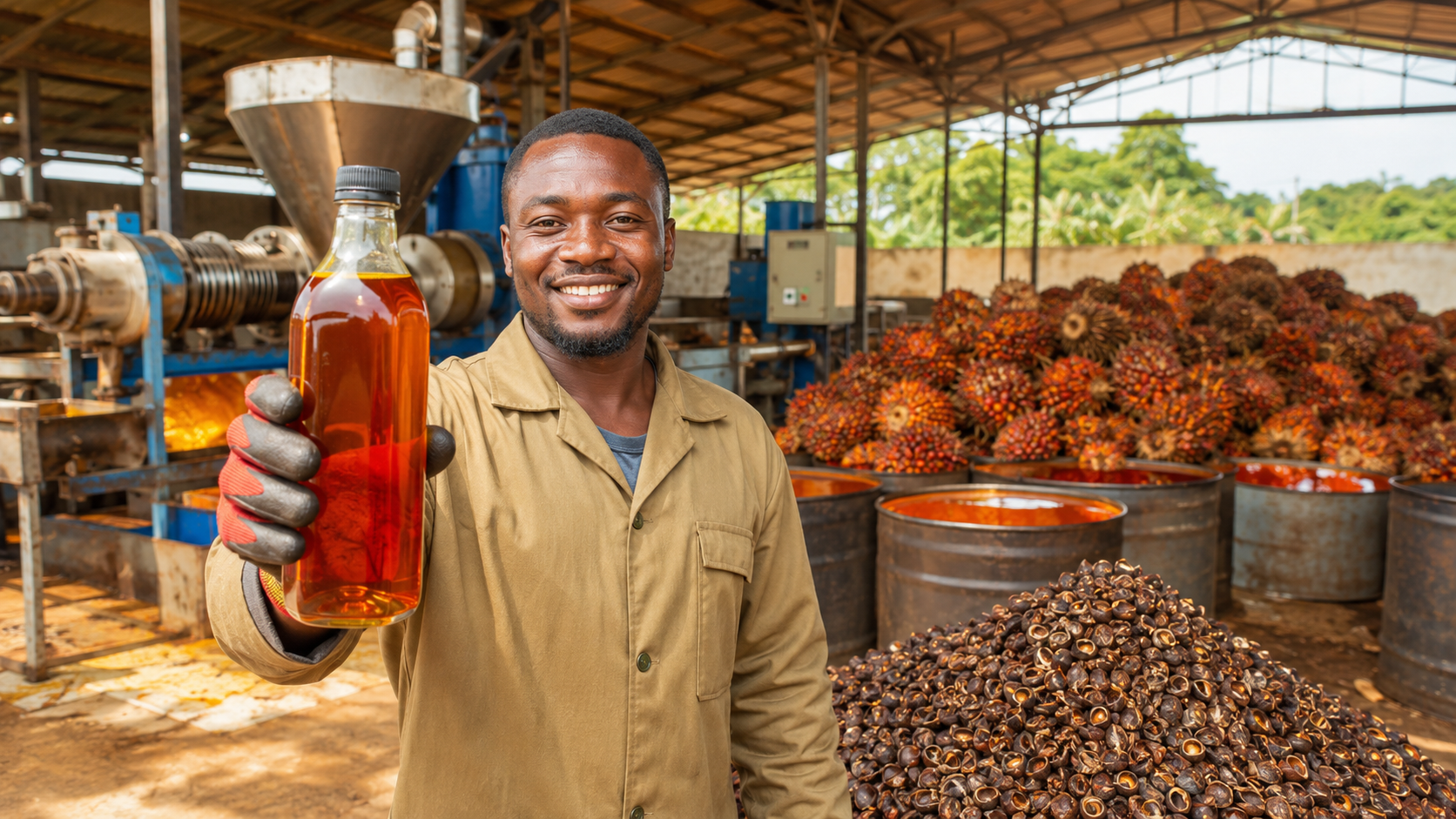
- Crude Palm Oil (CPO) Processing: This is the entry point. You buy Fresh Fruit Bunches (FFB) from farmers, boil, thresh, and press them to produce the red, thick oil used for local cooking.
- Palm Kernel Oil (PKO) Processing: This is a higher margin game. After extracting CPO, you are left with the nut (kernel). I see this as the “gold mine” of the industry. Companies like Ellah Lakes Plc are specifically rolling out 40-tonne-per-day PKO mills because the oil is used in premium products like cosmetics and industrial oils, while the cake is sold to feed mills .
- Refining (RBD Palm Olein): This is for the big players. You take CPO and process it into Refined, Bleached, and Deodorised oil (the yellow, liquid vegetable oil in bottles).
I suggest you start with CPO or PKO. As Uduak Odungide, founder of Udy Foods, proved, you can start by supplying high-quality, unadulterated CPO to “healthy-conscious” homes before scaling into a factory .
3. Your Equipment & Facility Roadmap
Let’s get practical. I know you are worried about cost. The palm oil processing business in Nigeria ranges from a backyard setup to a multimillion-naira factory.
If you are starting small (micro-scale), you might look at manual presses and digester machines. But I want to steer you toward the “small-scale mechanized” route. Data from 2026 suggests that a small-scale mill (processing 1–10 tons per day) costs roughly between ₦3 million and ₦7.5 million for traditional setups, while fully mechanized systems run into hundreds of thousands of dollars .
Here is exactly what you need for a standard processing facility:
- Digester: To mash the sterilized fruits.
- Screw Press: To extract the oil from the mash.
- Clarification Station: To remove water and impurities.
- Sterilizer/Cooker: Crucial for killing enzymes and making the fruit soft.
I must warn you about Adulteration. This is the “cancer” of the industry (literally). I shared the story of Ikechukwu Kingsley earlier. He lost his father to cancer linked to adulterated foods. Up to 80% of local market oil is mixed with Suddan dye or other chemicals . When you buy your equipment, you must prioritize quality to produce a pure product. That is your unique selling proposition (USP).
4. The Financial Reality: Costs, Margins, and The Import Threat
I won’t lie to you. 2026 is a tricky year. You need to be aware of the Domestic Pricing Power issue. While global prices are high, local prices dropped by roughly 30% recently due to a surge in imports that slipped through the ECOWAS borders .
However, do not let this scare you. I see this as a market correction that weeds out inefficient players. Here is the math you need to run:
- Raw Material: You need to source Fresh Fruit Bunches (FFB). You should partner with farmers in Edo, Cross River, Imo, or Akwa Ibom states to buy directly .
- Pricing Volatility: As of late 2025, a 25-liter keg was selling between ₦25,000 and ₦35,000 . Your profit lives in the “spread” between your production cost and this sale price.
- Waste to Value: This is where you win. For every ton of oil you produce, you generate 4.5 tons of waste (fibers, shells, effluent) .
- You can sell Palm Kernel Shell (PKS) to Poland and Portugal for energy generation.
- You can convert the mill effluent into methane gas for cooking.
- You can make briquettes from the fibers.
If you ignore the waste, you lose 40% of your potential profit.
5. The Secret Weapon: Sustainability as a Business Model
I want to tell you about Kendra Charles. She inherited a family mill in Otoloko. The oil was poor quality, the mill smelled bad, and no one wanted to buy. Then she learned sustainable practices .
What did she change?
- Process FFB within 48 hours: Leaving fruits on the floor ruins the oil quality (increasing Free Fatty Acids).
- Stop dumping effluent: She started managing her waste.
- Use briquettes for fuel: She stopped buying expensive firewood.
The result? You will love this: She tripled her production from 75 liters to 250 liters per month. Her income jumped from ₦150,000 to ₦500,000 weekly . That is the power of quality.
I urge you to apply for training. The “Pathways to Prosperity” project (supported by the Netherlands Ministry) is active in states like Anambra, Delta, and Kogi. Getting certified as a sustainable processor opens doors to export grants and high-end buyers .
6. Navigating Challenges (Power, Funding, and Talent)
Let’s address the elephant in the room. You cannot run a factory without power. I know that the cost of diesel is killing small businesses. However, note that the Abia State government recently restored power to industrial clusters after five years of blackout . You need to factor Solar or Bio-gas (from your own waste) into your budget to offset energy costs.
Regarding Funding: Interest rates are high. You might not get a bank loan easily. I suggest looking at the cluster model. Instead of buying your own massive mill, you set up a Shared Processing Facility. Farmers bring you their fruits, you process for a fee, and you aggregate the oil for bulk sale . This lowers your capital expenditure and secures your raw material supply.
Finally, talent. Young Nigerians often see agriculture as a “dirty business.” I recommend engaging NYSC corp members. They bring accounting, digital marketing, and management skills. As KR Foods does, you can upskill these young graduates, turning them into your future operations managers .
7. Your First 90 Days: A Step-by-Step Plan
I want you to stop dreaming and start acting. Here is your roadmap:
- Days 1–30 (Research & Registration):
- Days 31–60 (Setup & Sourcing):
- Buy your Digester and Press. (Budget for “unforeseen” import duties if buying from China).
- Secure a storage facility. Note: You need a clean, cool space; palm oil absorbs odors easily.
- Do a trial run. Process 500kg of FFB. Test the Free Fatty Acid (FFA) levels. You want low FFA for high prices.
- Days 61–90 (Branding & Sales):
- Branding is non-negotiable. Even if you sell in kegs, put a label with your NAFDAC registration number on it.
- Target the “Consumer Goods” market. Small suppliers like Udy Foods grew by targeting corporate clients and career women, not just the open market .
- Attend a trade fair in Lagos or Port Harcourt.
Conclusion: The Time is Now
I have given you the blueprint, the numbers, and the cautionary tales. The palm oil processing business in Nigeria is not a “get rich quick” scheme. It is hard work. You will fight with pricing volatility, power outages, and fragmented farmers .
But look at the evidence. Ellah Lakes Plc just went from zero to N359 million in revenue in a single quarter because they started processing . Udy Foods scaled from a 9-to-5 job to serving 10,000 homes . Kendra Charles tripled her income by simply cleaning up her act .
You have the market deficit on your side. You have the “Waste to Value” opportunity waiting to be tapped. You have the chance to provide safe, unadulterated food to a nation that desperately needs it.
So, turn off your phone, drive to the nearest oil palm plantation, and start. The value chain is waiting for you.
