

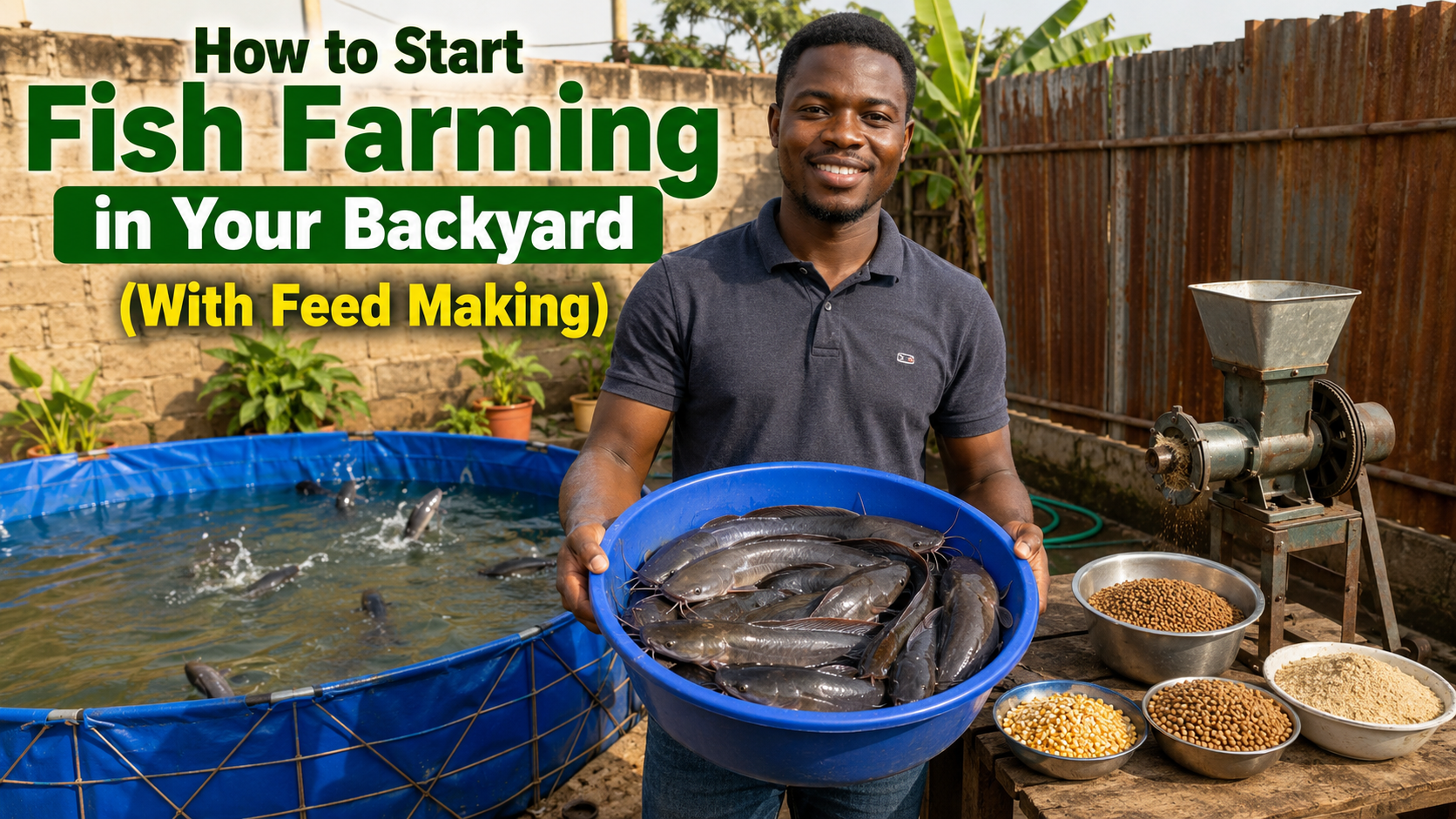
Starting a business from your own compound might seem like a distant dream, but in Nigeria today, start Fish Farming right in your backyard is one of the most accessible paths to financial freedom. You don’t need hectares of land or millions of naira to begin. You just need the right knowledge, a source of water, and the determination to follow through.
I have walked through successful small-scale farms in Ibadan, Lagos, and Port Harcourt that began with just two tarpaulin tanks and a borehole. These farmers are now earning six figures in profit every quarter, simply because they understood the secrets you are about to learn.
In this detailed guide, I will show you exactly how to start Fish Farming from scratch, avoid the costly mistakes that kill most beginners, and most importantly, I will teach you how to make your own fish feed to slash your expenses by up to 40%.
Here is your step-by-step blueprint to profitable backyard fish farming in Nigeria.
Why You Should Start Fish Farming Right Now
Before we dig into the mud and water, you need to understand the “why.” Nigeria has a massive fish deficit. We produce about 1.07 million metric tonnes of fish annually, but we consume over 3.6 million tonnes . That gap of over 2.5 million tonnes is currently filled by frozen imports from Norway and Chile.
What does this mean for you? It means the demand is already there. You don’t have to convince Nigerians to eat fish; they already love catfish in their pepper soup, grill, and jollof rice. You are simply stepping into a market that is hungry for local supply.
Backyard farming is specifically profitable because of low overhead costs. Research shows that infrastructure-based factors, specifically backyard farming and earthen ponds, contribute positively to your return on investment (ROI) . You save on land costs, security (your fish are in your house), and transportation.
Step 1: The 3-Day Pre-Start Checklist (Do this before buying water)
Many people rush to buy fingerlings and tanks immediately. Please, don’t be that person. Before you spend one naira on equipment, let’s get the fundamentals right.
1. Secure Your Water Source (The Non-Negotiable)
Fish live in water. If your water is bad, your fish die. You need a reliable source that is not dependent on erratic municipal supply.
- Borehole: This is the gold standard. Clean, consistent, and chemical-free.
- Deep Well: If the water table is high in your area, a well works, but you must test the pH.
- Rain Harvesting: Possible, but risky during dry season.
You also need to think about outflow. Where will the dirty water from the pond go? Ensure you have a drainage channel or a gutter nearby . You don’t want to flood your neighbor’s apartment.
2. Get Trained (Virtually or Physically)
I know you want to “just try it,” but failing is expensive. Data confirms that training participation significantly enhances efficient input usage and sustainable management .
Find a mentor. Many successful farmers (like Akinfish at Asher Ponds) offer online mentorship or physical farm visits. Spending ₦50,000 on a course now saves you ₦500,000 in dead fish later.
3. Know Your Market Before You Start
Don’t wait until harvest to look for buyers. Walk to the Mama Put (food canteen) down your street, the cold room, or the fish grill spot. Ask them: “If I bring fresh catfish, will you buy?” Often, smoked fish (dried) attracts a higher price than live fish. Processing your fish into smoked or dried form increases profit margins by up to 13% .
Step 2: Setting Up Your Backyard Pond (Choosing the Vessel)
Since you are starting in your backyard, you likely don’t have heavy machinery to dig an earthen pond. You have three excellent options for small-scale farming:
Option A: The Tarpaulin Tank (Best for Beginners)
This is my top recommendation for you. Tarpaulin ponds are mobile, durable (lasting 2-5 years), and affordable.
- Why it works: They are easy to clean. You can place them on any flat surface in your compound.
- Size Recommendation: A 10ft x 10ft x 4ft tarpaulin pond is ideal. It can hold approximately 800 fish comfortably .
- Pros: Low entry cost, no construction hassle, easy to drain.
Option B: Plastic/Fiberglass Tanks
If you have a small space like a garage or a side corridor, round plastic tanks (like the large blue ones used for water storage) are excellent. They are very strong and promote good water flow.
- Rule of thumb: For every 1 fish (from juvenile to table size), you need approximately 20-10 litres of water .
Option C: Concrete/Bricks (Permanent)
If you own your home and have the capital, concrete is durable (20-30 years). However, if you are renting an apartment, avoid this. You cannot move a concrete pond.
Preparation for any pond:
If using a new concrete pond, you must flush it with water for 2 weeks to remove the lime (cement residue) that has a high pH and will burn the fish’s gills. For tarpaulins, just wash with clean water and salt. Ensure there are no sharp objects under the tarpaulin.
Step 3: Sourcing Fingerlings (Your Seed Capital)
You cannot just catch fish from the river and expect profit. You need high-quality fingerlings (baby fish). The African Catfish (Clarias gariepinus) is your best bet because it is hardy, survives in low oxygen, and grows fast .
Clarias vs. Hybrids:
- Clarias: Tough, easy to manage, grows to 1kg in 4-6 months.
- Hybrid: Grows faster but requires better water quality. Slightly more expensive.
The Golden Rule of Stocking:
Do not overstock. Overcrowding causes stress, disease, and cannibalism (big fish eat small fish).
- For tarpaulin: 50 fish per square meter is safe.
- For tanks: 1 fish per 10-15 liters of water.
When you buy fingerlings, look for “active, uniform size.” If some are big and some are small, the big ones will eat the small ones. Always buy from a reputable hatchery, not the roadside vendor.
Step 4: Water Management (The 50% Rule)
If you feed your fish but don’t manage your water, you are wasting your money. Fish eat, digest, and poop. That poop turns into Ammonia (toxic to fish).
Your Weekly Schedule:
- Change 50% of the water every 3 days. Yes, you read that right. For a backyard setup without bio-filters, you cannot skip this.
- How to do it: Use a hose to siphon out the bottom sludge (where the poop sits), then top up with fresh, clean borehole water.
- Watch the Temperature: Do not change water in the afternoon sun. Do it in the cool of the morning or evening. A sudden temperature shock (e.g., cold borehole water hitting warm pond water) can kill all your fish.
Step 5: The Feed Secret (Your 3000-Word section starts here)
Why commercial feed is killing your profit:
Let’s do the math. A bag of commercial floating fish feed (Coppens, Skretting, Vital, or Bluecrown) costs anywhere from ₦25,000 to ₦35,000 depending on your location. Feed accounts for 60% to 70% of your total production cost .
The three factors that hit your profit the hardest are:
- Feed Price (Effect size: 0.27)
- Feed Conversion Ratio (FCR) (Effect size: 0.27)
- Product Price (Effect size: 0.32) .
If you can lower your feed cost, you have effectively doubled your profit margin.
The Art of Making Your Own Fish Feed (Save up to 50% Cost)
Many people are scared to make their own feed. They think it is complex. But look at the commercial farms—they all eventually produce their own feed because buying bags is simply not sustainable for growth.
You can produce high-quality feed for as low as ₦400 to ₦500 per kg, compared to commercial rates of ₦1,000 per kg .
The Ingredients (Where to find them in Nigeria)
You need to mix Proteins (for growth) and Carbohydrates (for energy).
1. Protein Sources (The most expensive part, but we make it cheap):
- Soybean Meal: Contains about 45% crude protein. You must “toast” or boil it to remove anti-nutritional factors.
- Groundnut Cake (GNC): A by-product of groundnut oil extraction. Very good for catfish.
- Fish Meal: Expensive, but you can replace 50% of it with insect meal!
- Black Soldier Fly Larvae (BSFL): This is your secret weapon. You can grow these in your backyard using organic waste (kitchen scraps). FUNAAB research shows that probiotic-fortified insect larvae can replace up to 50% of fishmeal without harming growth . Maggots are free protein.
2. Energy Sources (The Fillers):
- Maize (Corn): Use sparingly as it is hard to digest if not processed well.
- Wheat Offal / Wheat Bran: This is excellent. It acts as a binder to keep the pellets together.
- Cassava Flour: Good energy source, but low in protein.
3. Additives (For health and binding):
- Bone Meal: For calcium and minerals.
- Salt (Sodium Chloride): 0.2% of the mix helps with osmoregulation.
- Vitamins (Premix): Buy a small bag of “Fish Premix” from an agro-store. It contains essential vitamins (A, B, C, D, E).
- Methionine & Lysine: Essential amino acids. You only need tiny amounts (like a sachet of pure water).
The Simple Recipe (For 100kg of Feed)
Here is a practical “Starter Feed” formula that works perfectly for catfish from juvenile to harvest size (adapted from successful local farmers) :
- Soybean Meal: 30 kg
- Groundnut Cake: 20 kg
- Wheat Bran: 25 kg (Acts as a binder)
- Maize (Corn): 15 kg (For energy)
- Fish Meal (or Dried Maggots/BSFL): 8 kg
- Bone Meal: 1 kg
- Salt: 0.2 kg
- Vitamin Premix: 0.5 kg
The 5-Step Production Process
Step 1: Grinding
You cannot feed your fish chunks of maize or whole soybeans. They won’t digest it. You need a Hammer Mill (you can rent one at a local milling machine shop). Grind everything into a fine powder (like flour).
Step 2: Mixing
Get a large basin or a clean concrete floor. Pour all your powders together (Soybean, GNC, Bran, Maize, Fish meal). Mix dry, mix very well. Then add the small quantities (Bone meal, Salt, Premix). Mix again. You need a homogenous blend so one fish doesn’t get all the salt.
Step 3: Wetting (Conditioning)
Slowly add clean water to the powder while mixing. Don’t make it watery (soup). You want the texture of “wet sand” or “dough.” The dough should stick together when you squeeze it in your palm.
Step 4: Pelleting (Making the “Indomie” shape)
You need a Fish Feed Extruder/Pellet Machine (hand-operated or electric).
- Feed the dough into the machine.
- It pushes the dough through a metal plate with holes. Choose the hole size based on your fish’s mouth size (2mm for small fish, 4-6mm for big fish).
- The noodles come out long. Cut them into short “Indomie noodle” lengths (about 1-2 cm).
Step 5: Drying (The Most Critical Step)
If you feed wet dough directly to the pond, it will cloud the water in 30 minutes and pollute it.
- Spread the pellets on a clean mat or net in the sun.
- Let them dry for 1-2 days (depending on sun intensity) until they are “cracker hard.”
- The Float Test: Good catfish feed should float a little bit or sink slowly. If it sinks too fast, add more wheat bran next time.
Storage:
Once dry, store in airtight bags (like rice sacks) in a cool, dry place off the floor. If moisture gets in, mold grows, and mold kills fish.
Feed Management (How much to feed)
You don’t just throw food in. You must calculate.
- Feeding Rate: Feed them 3% to 5% of their body weight daily.
- Example: If you have 100kg of fish in the pond (total weight), feed 5kg of feed per day.
- Frequency: Split the food into two meals (Morning: 8 am, Evening: 5 pm).
- Observation: Watch them eat. If they finish the food in 5 minutes, you didn’t give enough. If it takes 30 minutes, you gave too much (and you are polluting the water). The target is 15-20 minutes to finish.
Step 6: Health and Growth Management (Sorting)
As your fish grow, some will grow faster than others. This is dangerous.
The “Big Fish – Small Fish” Problem: The big fish will eat the smaller fish when they are hungry.
Solution: Sorting.
- Every 4 weeks (once a month), you must drain the pond (partially or fully) and sort the fish.
- Put the “Big Ones” in one pond.
- Put the “Small Ones” in another pond.
- This ensures the small ones get enough food to catch up, and the big ones don’t turn into cannibals.
Step 7: Harvesting and Selling
When to Harvest?
Most catfish reach table size (1kg to 1.5kg) within 5 to 7 months.
- Month 1-3: Focus on growth (High protein feed).
- Month 4-6: Bulking up (Energy feed).
- Month 7: Harvest.
The Calculation (Where is your profit?)
Let’s run a small sample for a 500-fish operation:
- Cost of 500 Fingerlings: ₦50,000 (₦100 each)
- Cost of Feed (Homemade): You raised them for 6 months. Total feed used approx 400kg @ ₦500/kg = ₦200,000
- Water/Electricity/Misc: ₦30,000
- Total Cost: ₦280,000
Revenue:
- Out of 500 fish, you lose 50 to mortality (10% loss is normal). You have 450 fish.
- Average weight: 1.2kg each. Total weight = 540kg.
- Market price for live catfish (depending on your region) ranges from ₦1,000 to ₦1,500 per kg.
- Conservative Estimate: 540kg x ₦1,200 = ₦648,000
Profit: ₦648,000 – ₦280,000 = ₦368,000 profit in 6 months.
If you had used commercial feed, your feed cost would have been closer to ₦400,000, eating up your profit. That is why making your own feed is the secret to riches in this business.
Step 8: Scaling Up and Avoiding Pitfalls
Once you have harvested once and seen the profit, you will want to do it again. But here is my advice to ensure longevity:
Don’t use all your profit to buy luxury goods. Plow it back into the farm.
- Buy a Hammer Mill (so you don’t rent).
- Buy a Fish Smoker (Smoked fish sells faster and has a longer shelf life). Rent out your smoker to neighbors to make extra income.
The Number One Enemy: Theft and Stress.
- Theft: People will see you have fish. Do not tell everyone how much money you made. Keep your business quiet.
- Stress: You cannot travel for 3 days without someone checking the water. If the pump fails or the tarpaulin bursts, you lose everything. Install a simple “float valve” or have a trusted neighbor/employee.
Conclusion
You have everything you need to succeed right at your feet. You don’t need a loan to start Fish Farming; you need a tarpaulin, water, and the grit to mix your own feed.
The market is waiting for you. The demand for protein in Nigeria is exploding. While others are lining up for government jobs, you could be sitting in your backyard, watching your fish grow, and counting your profits at the end of the cycle.
Take the first step today. Buy that tarpaulin. Call that mentor. Grind that corn. Your journey to agribusiness wealth starts right now.
