

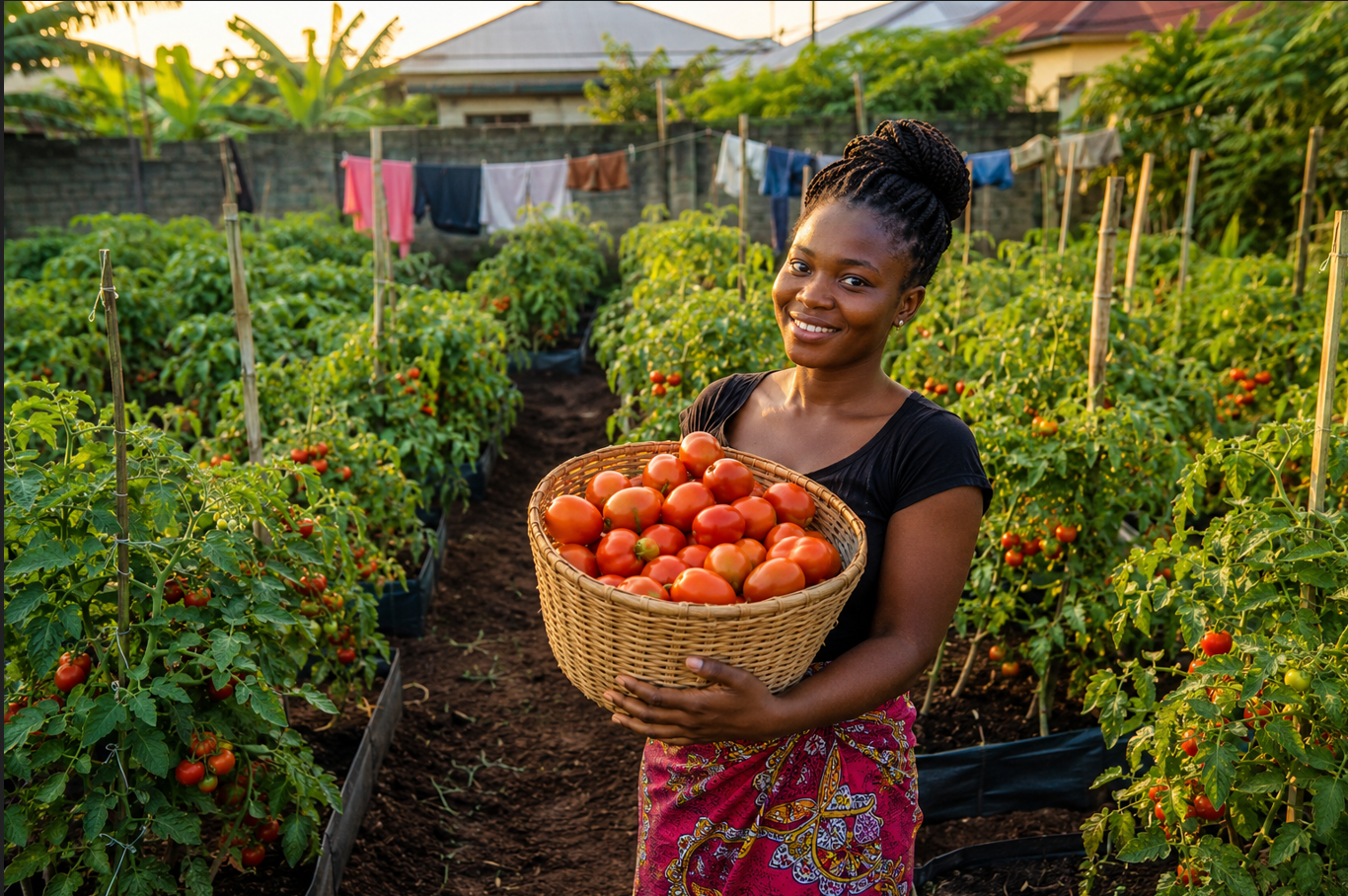
How to Grow Tomatoes from Your Backyard and Sell for Profit in Nigeria.
Why I Stopped Buying Tomatoes and Started Earning from Them
Let me be honest with you. A few years ago, I looked at my empty backyard in Lagos and saw nothing but weeds and wasted space. Like you, I used to complain about the skyrocketing price of tomatoes during dry seasons. I remember paying N500 for just three medium-sized tomatoes. That was my breaking point. I asked myself: If tomatoes are this expensive, why am I not growing them myself?
That question changed my life. Today, I want to show you exactly how to grow tomatoes from your backyard and sell for profit in Nigeria. Not as a hobby. Not as a small experiment. But as a real, money-making venture.
You don’t need hectares of land. You don’t need a loan. You just need your backyard, some basic knowledge, and the willingness to learn. I have done it, and I know you can do it too. In this post, I’ll walk you through every single step—from seed selection to selling your harvest for cash.
So, grab a notebook. Let’s get started.
Why Growing Tomatoes in Nigeria Makes Perfect Business Sense
Before I teach you how to grow tomatoes from your backyard and sell for profit in Nigeria, let me explain why this is one of the smartest backyard businesses you can start today.
Nigeria is the largest producer of tomatoes in West Africa, but we still lose over 40% of our harvest due to poor storage and transportation. What does that mean for you? It means demand is always higher than supply. It means that if you can grow healthy tomatoes in your backyard, you will never lack customers.
Think about it:
- Every household in Nigeria uses tomatoes for stew, jollof rice, soups, and sauces.
- Restaurants, bukaterias, and hotels buy in bulk.
- Even tomato paste factories source locally.
When you learn how to grow tomatoes from your backyard and sell for profit in Nigeria, you tap into a market that never sleeps. And the best part? Your production cost is low because you are using your own land, your own labor, and often your own compost.
Step 1: Choosing the Right Tomato Variety for Nigerian Climate
Not all tomatoes are equal. I learned this the hard way. My first attempt failed because I planted a variety that couldn’t withstand the heat or the occasional heavy rain. So, let me save you that stress.
To successfully grow tomatoes from your backyard and sell for profit in Nigeria, you need to pick high-yield, disease-resistant varieties. Here are my top recommendations:
- UC 82B – Very popular in Nigeria. Heat-tolerant and produces firm fruits that transport well.
- Roma VF – Excellent for paste and stew. High yield and resistant to verticillium and fusarium wilt.
- Cobra 26 – A hybrid that gives large, red fruits. Great for fresh markets.
- Tima – Drought-tolerant and early maturing (60–65 days).
You can buy these seeds from reputable agro-input stores or online from places like Premier Seeds Nigeria or Agropartnerships.
Step 2: Preparing Your Backyard Soil for Tomato Farming
Here is where most people fail. You cannot just throw seeds on bare ground and expect miracles. I did that once, and my tomatoes were small, sour, and diseased. So, let me show you how I prepare my soil.
To grow tomatoes from your backyard and sell for profit in Nigeria, you must start with rich, well-draining soil. Follow these steps:
- Clear the land – Remove weeds, stones, and debris from your backyard.
- Loosen the soil – Use a hoe or a garden fork to till at least 6–8 inches deep. Tomatoes have deep roots.
- Test pH – Tomatoes like slightly acidic soil (pH 6.0–6.8). In Nigeria, most soils are neutral or slightly acidic, but if yours is too alkaline, add sulfur or organic matter.
- Add organic manure – I use well-rotted poultry droppings or cow dung. Apply about 2–3 kg per square meter.
- Create raised beds – Because Nigeria rains can flood a backyard, raised beds (30 cm high, 1 meter wide) save your plants.
After doing this, your backyard is ready. Believe me, when you properly prepare your soil, you are already 70% successful.
Step 3: Nursery Bed or Direct Sowing? My Honest Advice
You have two options: start seeds in a nursery bed or sow directly in your backyard. I have tried both. For anyone who wants to grow tomatoes from your backyard and sell for profit in Nigeria, I strongly recommend starting a nursery bed first. Here is why:
A nursery bed allows you to:
- Protect young seedlings from pests and harsh sun.
- Select only the strongest seedlings for transplanting.
- Save space while seeds germinate.
Here is how I do my nursery:
- Find a shady corner of my backyard.
- Build a small bed (1m x 2m).
- Mix topsoil with compost (50:50).
- Sow seeds 1 cm deep, spaced 2 cm apart.
- Water gently every morning.
- After 3–4 weeks, seedlings are ready for transplanting.
Do not skip this step. It makes the difference between a failed patch and a profitable harvest.
Step 4: Transplanting Seedlings into Your Backyard
Once your seedlings have 4–6 true leaves and are about 6 inches tall, it is time to transplant. This is a thrilling moment. You are now one step closer to learning how to grow tomatoes from your backyard and sell for profit in Nigeria.
Here is my transplanting checklist:
- Spacing – Plant seedlings 60 cm apart within rows, and leave 75 cm between rows. Crowding invites diseases.
- Depth – Bury the stem up to the first set of leaves. Tomatoes can grow roots along buried stems.
- Time of day – Transplant in the late afternoon or on a cloudy day to reduce transplant shock.
- Water immediately – Give each seedling a cup of water after planting.
I remember my first transplant day. My neighbors laughed, saying, “You and your farming.” Two months later, they were buying tomatoes from me. So, ignore the critics. Just follow the steps.
Step 5: Watering, Mulching, and Feeding Your Tomato Plants
Water is life, but too much water is death. To successfully grow tomatoes from your backyard and sell for profit in Nigeria, you must master watering discipline.
- First week after transplant – Water daily (morning or evening).
- Second week onward – Water every 2–3 days, deeply.
- Rainy season – Reduce watering. Too much water causes fruit cracking and fungal diseases.
Mulching changed everything for me. I use dry grass, palm fronds, or even cardboard as mulch. Mulch keeps the soil moist, suppresses weeds, and prevents soil from splashing onto leaves (which spreads disease).
Feeding: After 3 weeks, start fertilizing. I use a balanced NPK 15-15-15 at a rate of one tablespoon per plant, placed 5 cm away from the stem. Then I water it in. Two weeks later, I switch to a potassium-rich fertilizer (NPK 12-12-17) to boost fruit production.
If you follow this feeding schedule, I promise you will see the difference in fruit size and taste.
Step 6: Staking and Pruning – Don’t Let Your Tomatoes Lie on the Ground
A huge mistake I see beginners make is letting tomato vines crawl on the ground. When fruits touch the soil, they rot, get eaten by insects, or develop soil-borne diseases. If you want to grow tomatoes from your backyard and sell for profit in Nigeria, you must stake your plants.
I use bamboo stakes (about 1.5 meters tall). Drive one stake next to each plant and tie the main stem loosely with soft cloth or jute rope. As the plant grows, I tie it every 2 weeks.
Pruning is equally important. Remove the “suckers” – the small shoots that grow between the main stem and branches. Why? Because suckers take energy away from fruit production. Also, remove yellow or diseased leaves immediately.
When I started pruning, my yield doubled. No exaggeration.
Step 7: Pest and Disease Management – Natural Methods That Work
Let me be real with you: pests and diseases will come. In Nigeria, we deal with tomato leaf miners, aphids, whiteflies, and fruit borers. Also, diseases like early blight, late blight, and bacterial wilt.
But don’t panic. You can still grow tomatoes from your backyard and sell for profit in Nigeria without heavy chemicals. Here is my integrated pest management routine:
- Neem oil spray – Mix 10 ml neem oil with 1 liter water and a drop of liquid soap. Spray every 7 days.
- Garlic-pepper spray – Boil 5 garlic cloves and 2 hot peppers in 1 liter water. Cool, strain, and spray. Repels aphids and whiteflies.
- Manual removal – Pick off hornworms or caterpillars by hand.
- Companion planting – Plant basil, marigold, or mint nearby. They repel nematodes and whiteflies.
For fungal diseases, ensure good air circulation by proper spacing and pruning. Also, water at the base of the plant, not on the leaves.
If you see bacterial wilt (sudden wilting even when soil is wet), remove the plant immediately and do not plant tomatoes in that spot for 2 years.
Step 8: Harvesting Your Tomatoes for Maximum Profit
This is the moment you have been waiting for. About 65–85 days after transplanting (depending on variety), your tomatoes will start ripening. To successfully grow tomatoes from your backyard and sell for profit in Nigeria, you need to harvest correctly.
I harvest when the fruits are 70–80% colored but still firm. If you wait until they are fully soft, they will bruise during transport. I use sharp scissors or a knife to cut the stem – never pull the fruit off.
How often? Every 2–3 days during peak production. A single healthy plant can give 3–5 kg of tomatoes over its lifetime.
Here is a pro tip: Sort your harvest. Grade A tomatoes (large, unblemished, uniformly red) go for premium price. Grade B (small cracks or odd shapes) can be sold cheaper or processed into paste. Discard rotten ones.
Step 9: Storing and Preserving Tomatoes for Off-Season Profits
One unique advantage you have when you grow tomatoes from your backyard and sell for profit in Nigeria is that you can store excess harvest and sell when prices double. Yes, double.
During peak harvest (November–January and June–August), tomatoes can sell for N20,000–N30,000 per basket. But during scarcity (February–April and September–October), the same basket can fetch N60,000–N80,000.
How do I store mine?
- Sun drying – Slice tomatoes and dry on a clean net for 3–5 days. Store in airtight bags.
- Tomato powder – Grind dried tomatoes into powder. Lasts 6 months.
- Blanched freezing – Boil water, dip tomatoes for 30 seconds, cool in ice water, then freeze in ziplock bags.
I also make homemade tomato paste. Boil, sieve, and cook down until thick. Bottle in sterilized jars. You would be shocked how much people pay for chemical-free, homemade paste.
Step 10: Selling Your Tomatoes – Where and How to Get the Best Price
Now, let’s talk money. You have learned how to grow tomatoes from your backyard and sell for profit in Nigeria. But where do you actually sell?
Here are the channels I use:
A. Direct to neighbors and local community
I start here. I tell my neighbors, church members, and WhatsApp group. No transport cost. I sell at slightly below market price but make good profit because I have zero logistics cost.
B. Local open markets (Mile 12, Onitsha, Bodija, etc.)
If you have 50–100 kg, you can take to the market or sell to a middleman. But be warned – middlemen can be tough. Go early (5 am) and know the prevailing price before you negotiate.
C. Small restaurants and bukaterias
I walk into 5–10 restaurants near my home and offer samples. I promise consistent supply. Many owners prefer buying from a backyard farmer because they get fresher tomatoes and can negotiate a fair price.
D. Online – Facebook and Instagram
Yes, people buy tomatoes online in Nigeria. I post pictures of my fresh, organic harvest. I offer delivery for a fee. You would be surprised – busy professionals love this service.
E. Processing into value-added products
This is my biggest secret. When prices are too low, I turn my tomatoes into powder, paste, or sun-dried packs. I label them “Backyard Fresh Nigeria” and sell at double the price of raw tomatoes.
Pricing Example (Based on 2025 rates)
- Raw tomato basket (25 kg) – N25,000 – N40,000
- Sun-dried tomatoes (1 kg) – N5,000 – N8,000
- Tomato powder (500g) – N3,500 – N5,000
- Homemade paste (750ml bottle) – N2,000 – N3,000
Step 11: Calculating Your Profits – Let’s Do the Math
I want you to see the numbers. Let’s assume you have a 10ft x 10ft backyard (about 9.3 square meters). You can plant roughly 30 tomato plants (spaced properly).
Costs (one season):
- Seeds (1 packet) – N1,500
- Manure/compost – N3,000
- Stakes and ties – N2,000
- Neem oil and sprayers – N2,500
- Water (assuming borehole or well) – N0
- Total = N9,000
Yield: 30 plants x 3 kg average = 90 kg of fresh tomatoes.
Selling at medium price: 90 kg = about 3.5 baskets (25kg each). At N30,000 per basket = N105,000.
Profit: N105,000 – N9,000 = N96,000 in just 3 months from a tiny backyard.
And that is without value addition. If you dry or powder half of it, profit can exceed N150,000.
Now imagine if you have a larger backyard, or you scale to two or three cycles per year. You see why I keep saying: learning how to grow tomatoes from your backyard and sell for profit in Nigeria is a financial game-changer.
Step 12: Scaling Up – From Backyard to Small Farm
Once you master backyard production, you can expand. I started in a 10×10 space. A year later, I rented an empty plot next to my house for N50,000 per year. My profit jumped to over N500,000 per season.
You can form a cooperative with neighbors. Each person uses their backyard. You share seeds, knowledge, and even marketing. Then you sell together in bulk.
You can also buy a rain gauge and simple drip irrigation (costs as low as N30,000 for a backyard setup). That way, you can grow in dry season when prices are highest.
Common Mistakes to Avoid (I Made Them So You Don’t Have To)
I failed twice before I succeeded. Here are the mistakes I made while trying to grow tomatoes from your backyard and sell for profit in Nigeria:
- Overcrowding – I planted too close, and diseases spread like wildfire.
- Overwatering – I killed half my first crop with love (too much water).
- Ignoring staking – Fruits rotted on wet soil.
- Harvesting too late – Soft tomatoes attracted fruit flies.
- Not keeping records – I didn’t track costs, so I didn’t know my real profit.
Learn from me. Keep a simple notebook or use your phone to record everything.
Frequently Asked Questions (From My Students and Neighbors)
Q: Can I grow tomatoes in a shady backyard?
A: Tomatoes need at least 6–8 hours of direct sunlight. If your backyard is too shady, consider growing cherry tomatoes (more tolerant) or clear some trees.
Q: How do I deal with lizards and birds eating my tomatoes?
A: I use bird netting and also plant a few sacrificial tomato plants away from my main bed. Also, keeping a cat or dog helps.
Q: Is it legal to sell tomatoes from my backyard in Nigeria?
A: Yes. There are no laws against selling homegrown produce. Just ensure you are not creating a nuisance or using unsafe chemicals.
Q: What if I don’t have a backyard at all?
A: You can use large grow bags or buckets on a balcony or rooftop. The principles are the same.
Conclusion: Your Backyard Is a Goldmine
I never imagined that my small, forgotten backyard would become a consistent source of income. Today, I do not buy tomatoes. I do not beg for stew ingredients. And every dry season, while others cry about high prices, I smile because my backyard is producing.
Now I am passing the baton to you. You have the step-by-step knowledge. You have the cost breakdown. You have the selling strategies. The only thing left is action.
So, I challenge you: start this weekend. Clear that patch of weeds. Buy your seeds. Build your nursery. In three months, you will look back and thank yourself.
If you follow what I have shared here, you will not only learn how to grow tomatoes from your backyard and sell for profit in Nigeria – you will also build a business that can pay school fees, buy household items, or even become your full-time career.
Do not wait for perfect conditions. Start small, learn fast, and grow.
Have you tried backyard tomato farming before? Or do you have questions about a specific step? Drop a comment below – I read every single one. Let’s grow together.
Ready to start? Save this post, share it with a friend who has an empty backyard, and let’s make Nigeria’s backyards green and profitable.
Disclaimer: Prices and yields mentioned are based on my personal experience and 2025 market rates in Lagos and Ibadan. Your results may vary depending on location, weather, and soil conditions.
